Passing Prop Firm Challenges in 2026
Let's look at what makes a good Prop Firm Passing strategy, and let's build an example together

What is a prop firm challange
Prop firm trading has become one of the most popular ways for traders to access larger capital without putting up the full account size themselves.
The idea is simple. A prop firm gives you a trading account. If you make profits and follow their rules, you receive a share of those profits. But before you get funded, you usually need to pass a challenge.
That challenge is where things become difficult.
Most prop firm challenges are not only about making money. They are about making money while staying inside strict rules. You may need to reach a profit target, avoid a maximum daily loss, stay below a total drawdown limit, and trade in a way that does not violate the firm’s conditions.
That means a suitable prop firm strategy should not only look profitable in a normal backtest. It should also be built around the actual goal of a challenge: reaching the profit target without hitting the drawdown limits.
Disclaimer: Templates are for educational purposes only!
👉 Get the Prop Firm Challenge Automation Template → Template Link
This template is designed to run on the 5-minute timeframe, with the best backtest results on AUDCAD
You might also want to watch the full YouTube video on this Prop Firm Challenge strategy here to get the full explanation of the strategy, the chart examples, and the Profectus AI blocks used to automate it.
Why This Strategy Is Interesting for Prop Firm Challenges
For many prop firm challenges, the goal is to reach around 10% profit without breaching the maximum drawdown rules. The strategy does not have to be the greatest strategy on earth. It simply needs to fit that very specific objective.
In this specific case, we are looking for large winning streaks that can add up to reach the challenge’s objective, before reaching the maximum drawdown limit. This specific strategy is designed in favour of getting big winning streaks. It’s not a safe strategy by default, but the mechanics are specifically designed to have a high chance of reaching the profit target of a prop firm challenge, before reaching the maximum allowed drawdown.
Prop Firm Challenge Strategy Rules
Let’s first look at the exact strategy rules. For simplicity reasons, let’s walk through the buy-side for this strategy.
- Run on the 5-minute timeframe.
- Only trade between 08:00 and 19:00.
- Daily limit must still allow trading. This means that the maximum daily drawdown (defined by you in the inputs list) has not yet been reached.
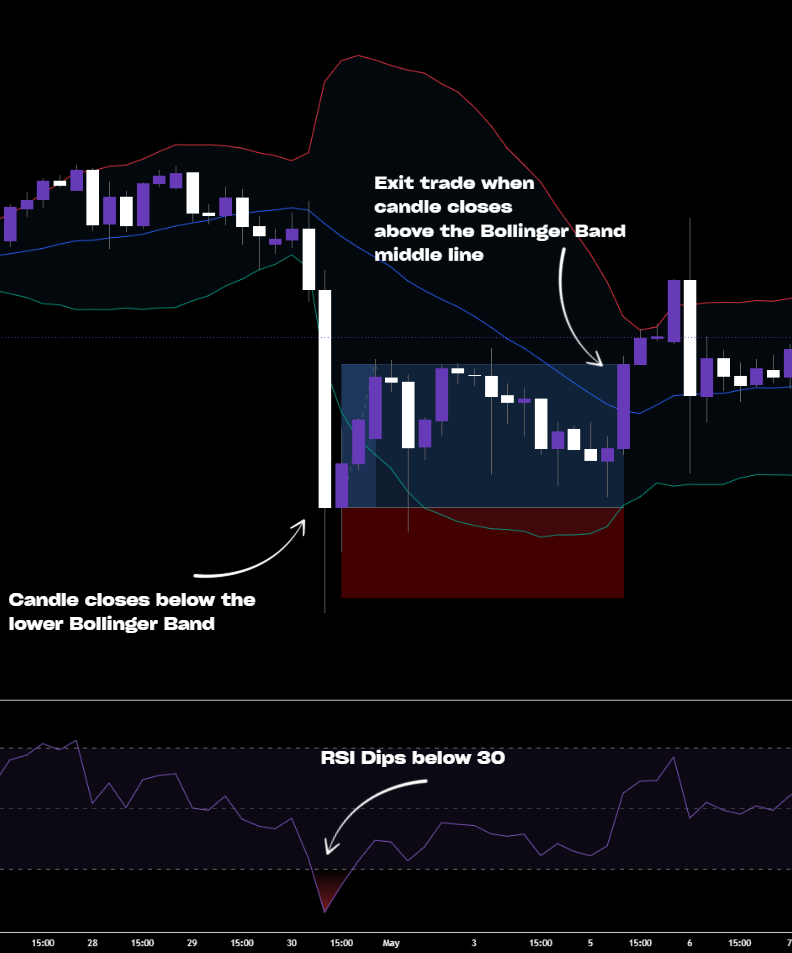
- Candle close of Candle ID 1 must be below the lower Bollinger Band.
- RSI period 10 must be below 30.
- Higher-timeframe buy confluence must be true. This higher timeframe confluence is that the 1-hour candle must also be below the lower Bollinger Band at the time of entry on the 5-minute timeframe.
- There must be zero buy trades and zero buy pending orders.
- Place a buy pending order at the candle close from step 4, with a 2 pip offset
- The stoploss is placed at 50 pips (changeable in the Inputs)
- Take profit at the Bollinger middle line.
- Delete the order after 15 minutes if it is not triggered.
This is an example of a trade setup taken with the Challenge Strategy.

Automating the Strategy in Profectus AI
Now let’s walk through how the strategy is built inside Profectus AI.
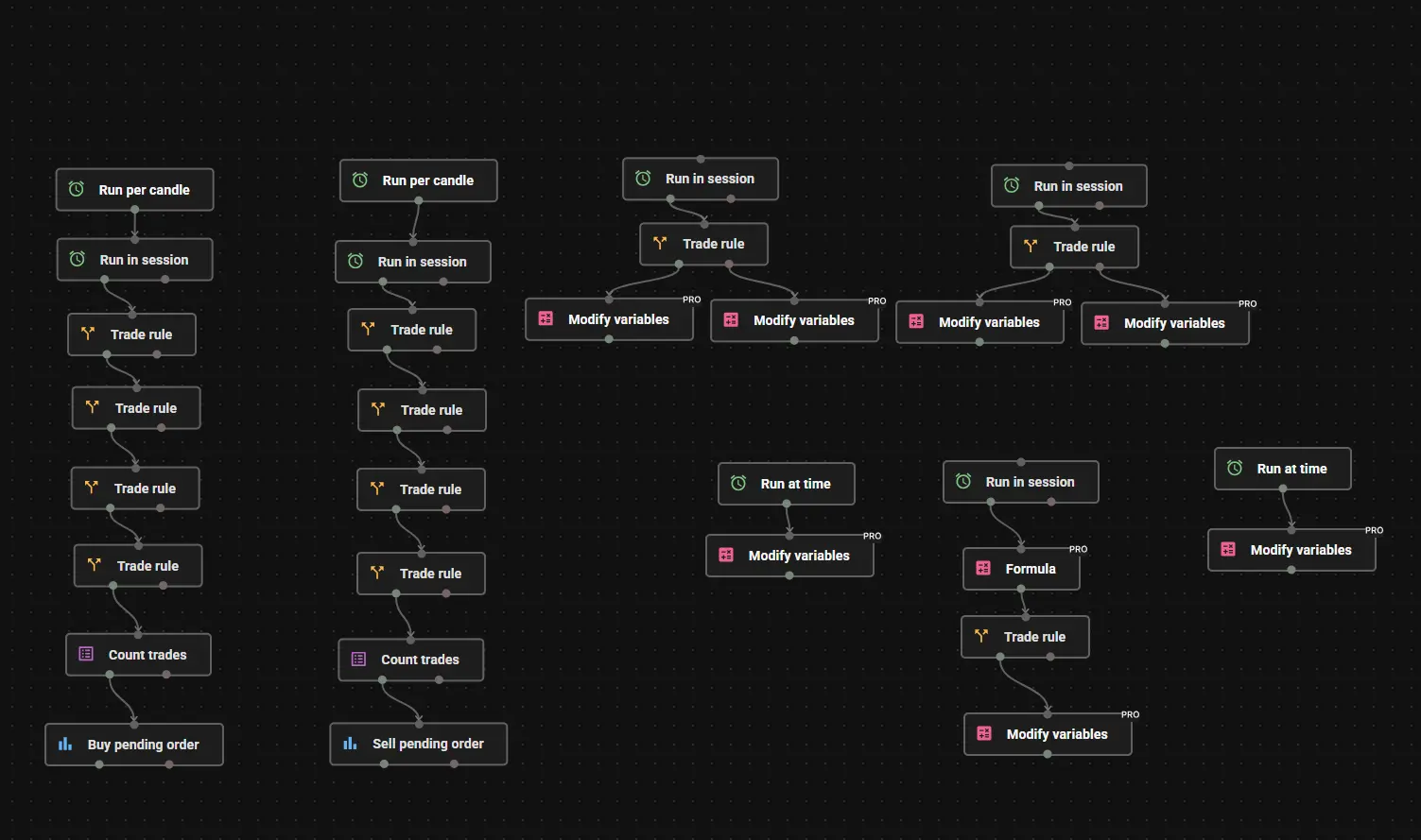
The block structure may look large at first, but the system is actually very logical. It is split into separate trees:
- The buy entry logic.
- The sell entry logic.
- The daily drawdown protection logic.
- The higher-timeframe confluence logic
- Initiate the variables. As always we start by creating our inputs and variables:
Variables
Floating_drawdown
Balance
Daily_Limit
HTF_confluence_buys
HTF_confluence_sells
All with default value 0
Inputs
Max_Daily_Loss
SL_Pips
Start_time (time)
End_time (time)
- Let’s focus on the buy-side only again for this example. We start with the time blocks. Put a run per candle block followed by a run per session block. Use the time inputs on the run per session block for your time configurations.
- Trade rule Daily Limit. The first rule we check is if the daily drawdown limit has not yet been reached. We do it like this:
Daily_Limit = 0
If the variable Daily_Limit is 0 it means that the limit has not been hit and it’s safe to trade. - Trade Rule Bollinger Band Close. Check if:
Candle close Candle ID 1 < Bollinger band (default settings) Lower Line - Trade Rule RSI. Check if:
Indicator Relative Strength Index (period 10) < 30 - Trade Rule HTF confluence. Check if:
HTF_confluence_buys = 1 - No open trade. Use a Count trades block with open trades and pending orders = 0
- Buy pending order.
Open price: Candle close candle ID 1, Price offset: 2
Money management: Fixed volume (up to your own preference)
Stop-loss: Fixed pips SL_Pips (the input)
Take-Profit: Custom price level -> Indicator-> Bollinger Band Middle Line - Higher timeframe confluence.
Run in session block (start time and end time inputs) -> Trade Rule Block (Candle low Candle ID 0, Timeframe 1H -< Indicator Bollinger Band Lower Line, Timeframe 1H
True output = Modify variables HTF_confluence_buys = 1
False output = Modify variables HTF_confluence_buys = 0 - Calculate the daily opening balance. Take run at time block and put the time at 1:00.
Connect it to a Modify variables block, and put:
Balance = Account, Account Balance - Calculate the floating daily drawdown. Start with a run in session block and put the start time and end time inputs.
Connect this to a formula block with the following formula:
Floating_drawdown = Balance - Account (Equity) - Put a trade rule block after the formula. Trade rule block:
Floating_drawdown >= Max_Daily_Loss (the input) - Reset the Daily measurements. Take a run at time block and put the time 22:00 (just before market close). Connect a Modify variable block and modify:
Daily_limit = 0
Floating_drawdown = 0
And that’s it! By following these steps you have now build this Prop Firm Challenge strategy all by yourself.
Get Access to the Prop Firm Challenge Strategy Template
Want to see how the Prop Firm Challenge Strategy works when fully automated?
Access the automation template used to turn this trading concept into a deployable MQ5 trading bot inside Profectus AI. The template includes the 5-minute Bollinger Bands and RSI entry logic, higher-timeframe confluence, pending order placement, session filtering, and the daily drawdown protection module.
Disclaimer: Templates are for educational purposes only!
👉 Get the Prop Firm Challenge Automation Template → Template Link
This template is designed to run on the 5-minute timeframe, with the best backtest results on AUDCAD
You can test it on different symbols, adjust the lot size, change the stop-loss input, test different pairs, and review whether the strategy fits the rules of the prop firm challenge you are interested in.
Other related blog posts
Dive into a world of knowledge, trends, and industry updates on the Variable blog. Our curated content covers a spectrum of topics.