How Maarten Found Consistency With Automated Trading
How Maarten went from almost giving up on trading to consistent success with automation
.webp)
Maarten is a 25-year-old trader from the Netherlands who works in process optimization at a large retail company. Alongside his job, he has built a complete systematic trading operation around no-code automation. This allows him to successfully trade a portfolio of automated strategies and to continuously develop and test new strategies.
That wasn’t always the case. For years, Maarten traded manually and struggled to find consistency. His Supply & Demand strategy got him funded, but as a result of the inconsistency, he lost his funded account. Eventually, he reached the point where he concluded that trading simply wasn’t for him, until he discovered automated trading.
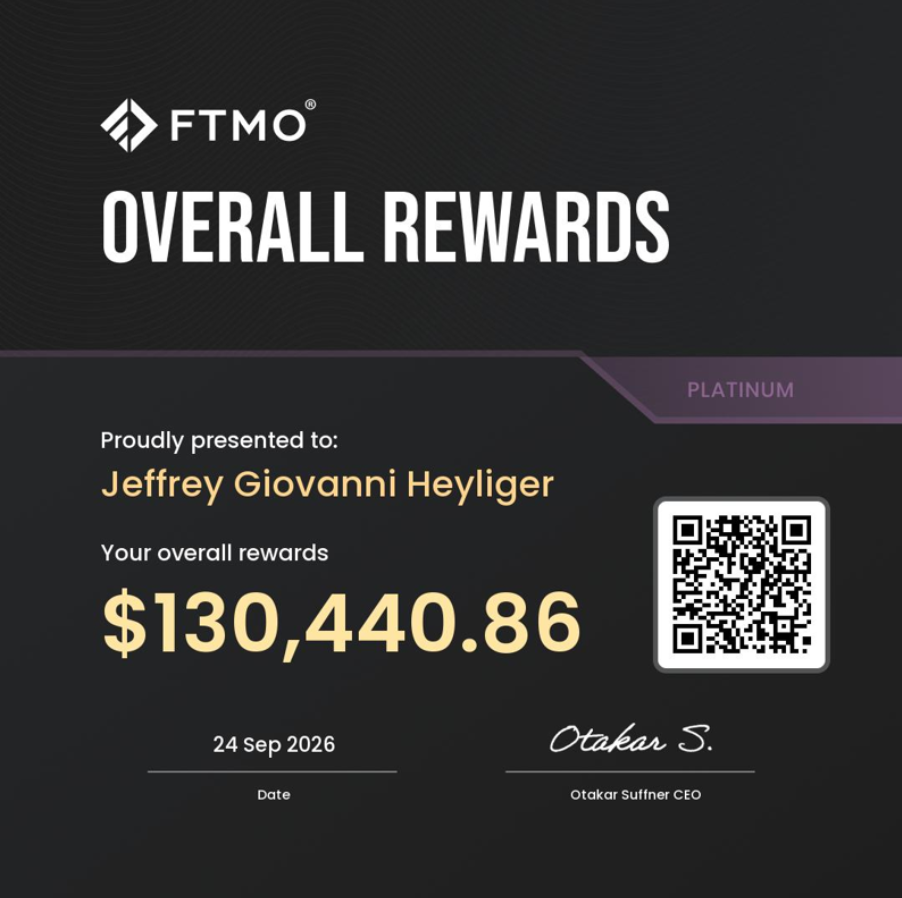
Today, he has passed multiple prop firm challenges, received payouts, secured a Darwinex allocation, and built a live track record that he considers the most important validation of his approach.
You are all able to follow his results through his live track record here.
Let’s dive into the interview with Maarten.
Who are you, and what does your life look like outside trading?
I’m Maarten, I’m 25, and I’m from the Netherlands. I have a full-time job in process optimization at a large retail company, and alongside that I’m a no-code automated FX trader. Even though trading is not my full-time occupation, it has become a very serious part of my life. It’s something I’m continuously building toward.
Why did you start trading?
I always wanted to work in finance. Working with money feels natural to me, and that is why I was attracted to trading in the first place. I faced some hardship with trading early on, and I started doubting myself and my passion for trading.
However, I also knew that I wanted a career that gives me freedom. Having the ability to decide what I do, when I do it, and how I spend my time. I think that was the main reason why trading continued to be an appealing choice for me.
What did trading look like in the beginning?
I traded manually for years using technical analysis. My strategy was mainly based on Supply & Demand concepts, and I spent a lot of time trying to make that approach work. I even managed to get funded at one point, but I eventually lost that account as well.
The biggest problem with my manual trading was that I never got the consistency I wanted. After years of trying, I eventually gave up on trading completely. At that point, I genuinely concluded that I just wasn’t made for it.
Looking back, why do you think manual trading didn’t work for you?
I think one of the biggest issues was what I would call operational slippage. I didn’t always do what I knew I should do. For instance, sometimes I missed trades because a trade setup presented itself at night, while I was asleep. I couldn’t take this trade, and it would screw up the odds. Or, after a large losing streak, my emotions would start interfering with my decision-making. Even if I knew the rules by heart, there was still a difference between knowing what I should do and actually executing it consistently.
Another major problem was that I didn’t fully understand probability. That had a big impact on my trading psychology. I had manually backtested for years, but I never had a truly robust sample size. I didn’t have enough data to trust my edge in every situation. So when things went badly, I didn’t really know whether I was experiencing a normal losing streak or whether the strategy itself had stopped working.
How was your introduction to automation?
At first, automation felt overwhelming. I didn’t really know where to start, and I knew it would require a serious amount of deep work. It felt almost like learning a new language. That held me back for a while.
What eventually pushed me to commit was seeing promising results from people within my own trading network. Once I saw what was possible, I decided to fully commit to learning no-code automation.
Why did you choose Profectus instead of buying an EA or having one built for you?
I had already bought EAs before, and one of the biggest problems was that I didn’t really understand what they were doing. For example, a system might go through ten losses in a row. I would panic, close the account, or stop trading it, and then the same system could go on a massive winning run without me. It was like the same problem I had with my manual trading and my backtest data; I didn’t understand the probabilities.
The problem wasn’t necessarily the system. The problem was that I had no idea what a normal losing streak looked like for that strategy. I also couldn’t properly test and verify the strategies I had bought on a validated dataset.
When I started looking into automation, LLM-generated code wasn’t really an alternative for me either. At the time, it was simply too error-prone for me to trust with real money. And even now, when I test strategy ideas generated by tools like ChatGPT or Claude, they never end up profitable, even in the backtest. I am not surprised since the internet is mostly filled with trading nonsense.
Profectus gave me the tools to build my own strategies and, more importantly, test everything myself. That was the big difference for me. I didn’t want someone else to tell me a strategy worked. I wanted to be able to prove it for myself.
What was the first strategy you built?
The first one I remember building was based on an engulfing pattern combined with several moving averages. The idea was fairly simple. Price had to be above or below a certain moving average, and a shorter moving average had to cross a longer moving average to confirm the trend.
At the time, I was convinced it would work. Both elements made intuitive sense to me as momentum signals, so I thought combining them should produce something profitable.
Then I ran the backtest. It blew up the account. That was actually a really important moment for me because it taught me something I still follow today:
Conviction means nothing without data.
Since then, I only trust strategies that survive the backtest.
What does your trading look like now, day to day?
Operationally, there isn’t much left for me to do. I check my servers every day to make sure everything is still running. MetaTrader updates or servers that reboot are the only form of operational slippage I still have.
The rest of my time goes into development. Every week, I build new systems and write new trading plans to test. My backtesting PC runs day and night because I want to generate as much data as possible.
So instead of spending my time watching charts and waiting for setups, most of my time goes to researching, building, and testing.
What kind of results have you achieved so far?
I’ve passed multiple prop firm challenges, received payouts, and secured a Darwinex allocation. But for me, the live track record matters the most. That is the real validation.
Backtests matter, but I ultimately want to see the systems behave as expected in live market conditions. That track record gives me confidence that the process I’m using is actually working beyond historical data.
What has been the biggest mindset shift?
Realizing that this is a volume game. Building as many strategies as I can so I can cherry-pick the best ones and put them in a portfolio.
I’ve always been a hard worker, so once I understood that, the process became much clearer. My job is to build as many systems as I can, test them thoroughly, and enjoy that process.
Previously, I would set an outcome goal. Something like:
“I want to make €10,000 per month.”
The problem is that I can’t directly control that outcome. What I can control is the input, and that has changed my goal. For example:
“I’m going to build 10 systems this month.”
Once I made that switch from outcome goals to input goals, everything started falling into place. I’ve now been consistently profitable for more than a year, and for me, going full-time has become a question of continuing to put in the work and maintaining that volume.
What would you tell someone who is where you were a year ago?
Stop looking for shortcuts. Make it a volume game. Set goals based on your own input instead of only focusing on all the money you want to make.
And start immediately. Ask questions. Find people who can help you learn the skill properly. There’s a lot to learn, especially when you first move from manual trading into automation.
But if you keep learning, building, and testing, that knowledge compounds.
That’s how I believe you give yourself a real chance of making it in the financial markets.
From Trying to Predict Markets to Building a Process
Maarten’s journey is a useful reminder that moving into automated trading doesn’t necessarily mean finding a better prediction method. His first automated strategy failed. And many of the ideas he tests today still fail.
The difference is that failure is now part of the process. An idea can be built, tested, and rejected within days, instead of months. And perhaps the biggest transformation has been in how progress is measured.
Instead of asking, “How much money did I make this month?” the focus becomes, “How many serious ideas did I build and test?”
For Maarten, moving from outcome goals toward controllable inputs turned trading from something he had already given up on into a repeatable development process. And after more than a year of consistent profitability, that process is now what he trusts most.
Note: Past trading results are not a guarantee of future performance. This interview describes Maarten’s personal experience and results.
Other related blog posts
Dive into a world of knowledge, trends, and industry updates on the Variable blog. Our curated content covers a spectrum of topics.