From Manual Trading to Automation: The Journey to $130K+ in Rewards
A conversation about the transition from manual trading to systematic execution, the importance of control, and the process behind building automated strategies
From Manual Struggles to Automated Success
In this new format, we are going to interview Profectus users and share their stories with you. These stories are inspiring to say the least and we can’t wait to share them with you.
In this first episode, we will share the story of Jeffrey, who managed to reach $130k+ in Prop Firm payouts with his automated trading systems. The payouts continue to grow, and you are all able to follow his results through his live track record and Darwinex profile.
Jeffrey Heyliger is a 25-year-old trader from the Netherlands who recently left his job at a large private bank and wealth manager to focus on trading full-time. After years of manual trading, missed setups, failed systems, and plenty of backtesting, he eventually found his way into automated trading.
Today, most of Jeffrey’s actual trading takes only a few minutes per day. His systems handle the execution, while he spends most of his time researching, building and testing new strategies. We spoke with Jeffrey about how he got started, what went wrong in the early years, why he moved toward automation, and how that journey eventually led to more than $130,000 in FTMO rewards.
Let’s dive in!
Why did you start trading?
To be honest, when I first started, I just wanted to get rich.
I was around 16 at the time, so I think that’s probably quite a typical motivation when you first discover trading.
As I got older, though, that changed. It became less about being rich and much more about being free. For me, that means freedom in terms of time, location, and finances. That’s by far my biggest reason for trading now. And I am in the process of realizing this goal.
Take us through your trading process at the beginning
At the very start, I was basically just copying setups I found on Instagram. Of course, that didn’t work out very well.
After that, I joined New Capital and started trading the Supply & Demand strategy taught by Max. That period taught me a lot because I started taking trading more seriously and spent a lot of time backtesting.
The main problem was that I was still in school at the time. I simply couldn’t be behind the charts whenever a setup appeared, so I missed a lot of trades.
At one point, I also bought an EA (automated trading system for MetaTrader 5). It was my first experience with automated trading, but it was not the best. That EA blew up during COVID, and I lost a lot of money.
That was probably the lowest point of my trading career.
Looking back, why do you think manual trading didn’t work?
There were several reasons. Time was definitely one of the biggest ones. If you trade manually, you need to be available when your setups happen. When you combine that with school or a job, that can become difficult very quickly.
But there was also a psychological side to it. I was too focused on making money, and I didn’t have enough trust in my own trading skills, my strategy, or my ability to execute consistently.
That lack of confidence affected the way I traded.
When did you start thinking about automation?
It happened right when I was getting close to giving up on trading. Max introduced me to automated trading, and I was immediately interested because almost every benefit he explained solved a problem I was struggling with at the time. I didn’t really doubt it.
At that point, I saw automation as my only real route forward in trading.
Why did you choose Profectus instead of buying another EA, hiring a developer, or using AI to generate one?
For me, it comes down to one word: control.
I had a very bad experience with a bought EA. I didn’t know how the EA functioned, and I didn’t know the logic behind it.
If you’re running automated trading strategies, I think you should understand what they are doing, how they perform, how they are built, and how you can improve them.
With a bought EA, a freelancer, or even an LLM, you can lose part of that control. AI-generated code is especially interesting right now because it’s becoming so popular. But if you write a few prompts, get a complete strategy back in a programming language you don’t understand, and then start trading it, you have no idea what you’re actually doing.
It might look impressive because everything has been automated for you, but to me it’s basically like driving a car while being blindfolded. I want to understand the strategy I’m trading.
What was the first strategy you built?
I remember my first strategy being based on the “Three White Soldiers and Three Black Crows” candlestick patterns. It was actually a very simple strategy, and it wasn’t profitable on its own. But that wasn’t the most important part for me.
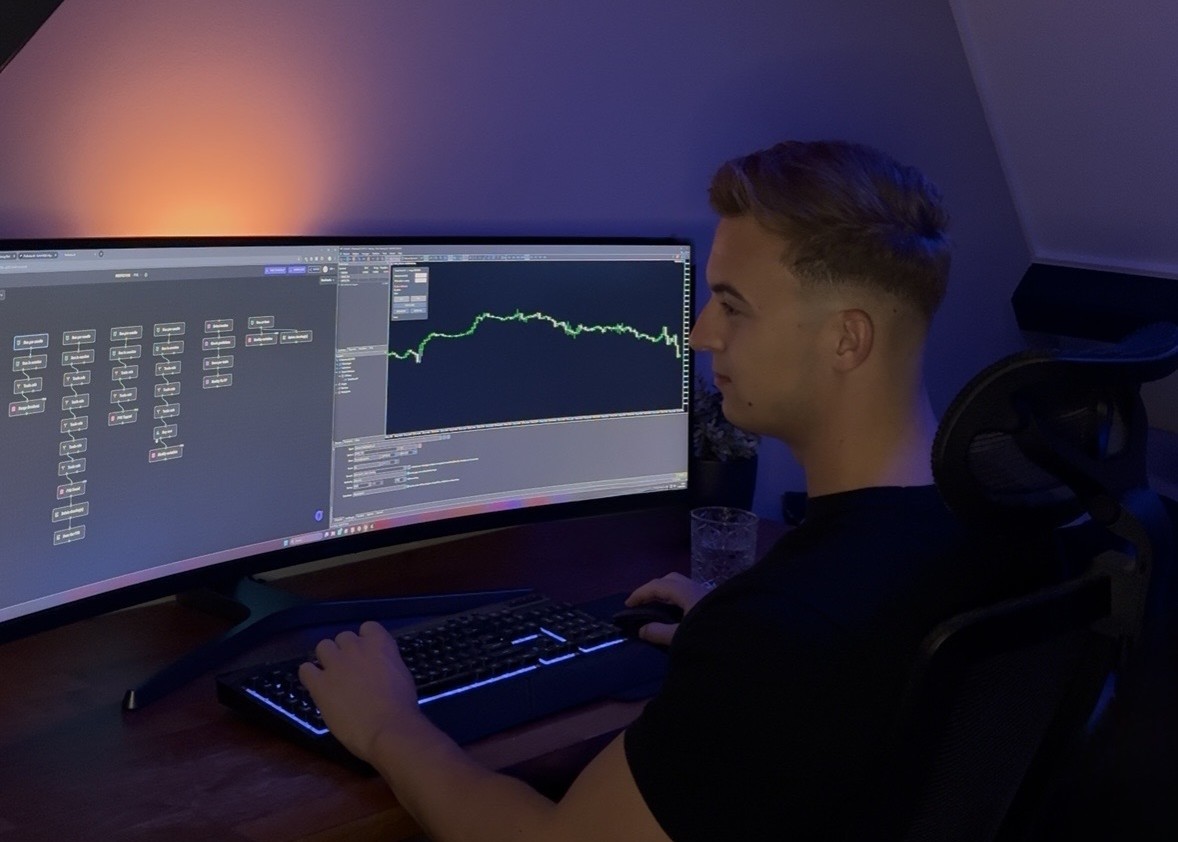
What really fascinated me was how quickly I could generate a backtest and how easily I could change the strategy inputs and test another variation. That completely opened my eyes.
Even though the first strategy itself wasn’t profitable, I realized how powerful the process was. I could take an idea, test it quickly, change it, and immediately see what happened.
That really motivated me to continue with automated trading and especially with building systems that are actually profitable.
What does your trading look like today?
The actual trading takes me only a few minutes per day. I mainly check whether my systems are up and running properly. That’s basically it. Sometimes I still look at the charts, but it’s not really necessary anymore.
Most of my time now goes into building and testing new strategies instead of manually executing trades.
What kind of results have you achieved so far?
The results have been really strong lately.
I currently have both a Darwinex and an FX Blue track record. The FX Blue account is actually the master account behind the Darwin, before the Darwinex risk engine is applied.
That account trades at around 0.5% risk per trade, so the risk settings are relatively conservative.
Even with that level of risk, I’ve been able to generate very strong returns. Prop firms have also been a big part of my results. My overall FTMO rewards are now well above $100,000.
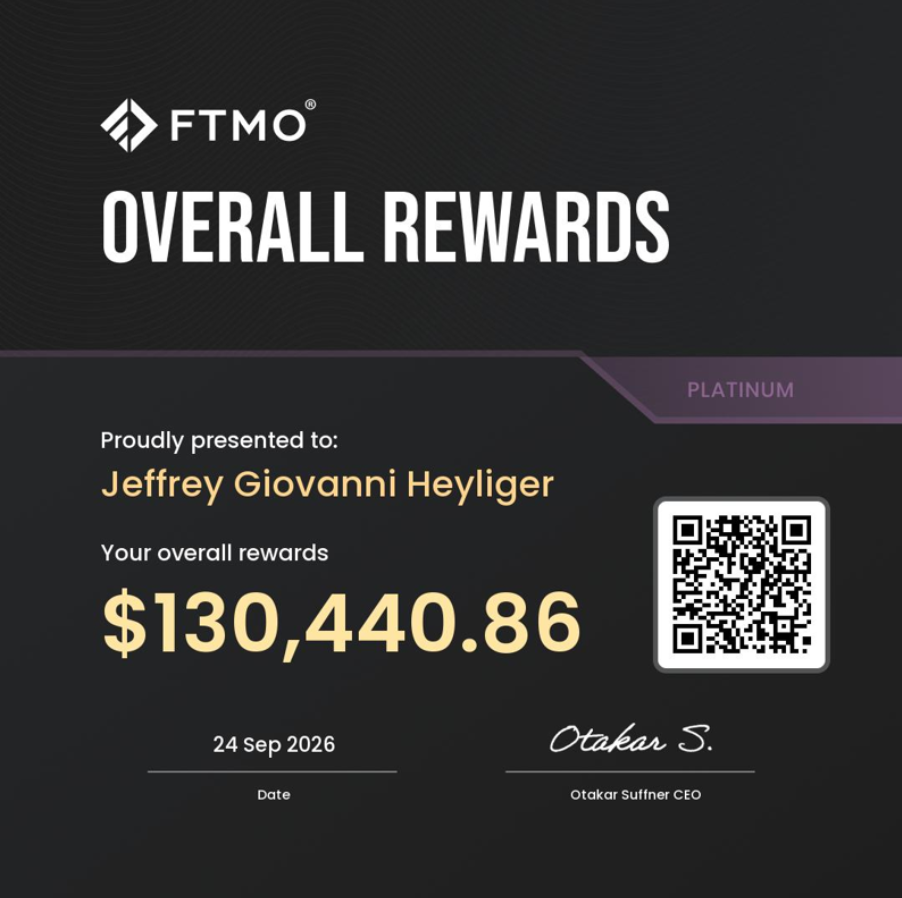
At the time of this interview, Jeffrey’s FTMO Overall Rewards certificate showed total rewards of $130,440.86.
What has been the biggest mindset shift for you?
The biggest difference is probably confidence in myself and my systems. When I was trading manually, there was always that question of whether I executed the trade correctly.
Now I know exactly how my systems are supposed to trade. I know the statistics. I know how the strategy is built. I know the rules. And I know that the system is going to execute those rules exactly as I planned them. That gives me a huge amount of confidence compared with how I felt when I was trading manually.
Of course, you never know what the market itself is going to do, but I no longer have to worry about whether I executed my own strategy correctly.
What would you tell someone who is where you were a few years ago?
It can be really tough to keep putting in months of hard work without seeing the results you want. And ultimately, the result most traders want to see is profit.
I know what that feels like. It took me years to become consistently profitable, and that actually represents the majority of my trading career so far. It definitely doesn’t come easily.
But I also found that once you start becoming more experienced and you finally have some results that prove your skills, things can accelerate really quickly. You start trusting what you’re doing more, you understand the process better, and everything becomes easier to build on from there.
From Executing Trades to Building Systems
Jeffrey’s journey is a good example of how automated trading can change the role of the trader.
The goal isn’t necessarily to remove yourself from trading altogether. Instead of spending your time waiting for setups and manually executing trades, that time can move toward research, backtesting, and improving the systems themselves.
For Jeffrey, the biggest change was not simply automation. It was gaining control over his process. Today, he can define an idea, build it, test it, understand its statistics and then let the system execute those rules exactly as designed.
And after years of trying to make manual trading work, that change in process has helped turn trading into something he can now focus on full-time.
Disclaimer: Past trading results are not a guarantee of future performance. This interview describes Jeffrey’s personal experience and results.
Other related blog posts
Dive into a world of knowledge, trends, and industry updates on the Variable blog. Our curated content covers a spectrum of topics.