Building a High Win-Rate Prop Firm Strategy
Let's build a profit-generating machine for Prop Firm Funded accounts
The Prop Machine
In the previous article, we focused on building a strategy that could help you pass prop firm challenges. In this article, we are going to build a strategy that can help you generate consistent returns on the funded account.
The goal is to generate payouts once the account is already funded. Let’s first highlight the fact that the type of strategy we are going to use is a HIGH-RISK strategy and should only be used for educational purposes.
Disclaimer: Templates are for educational purposes only!
👉 Get the Prop Machine Automation Template → Template Link
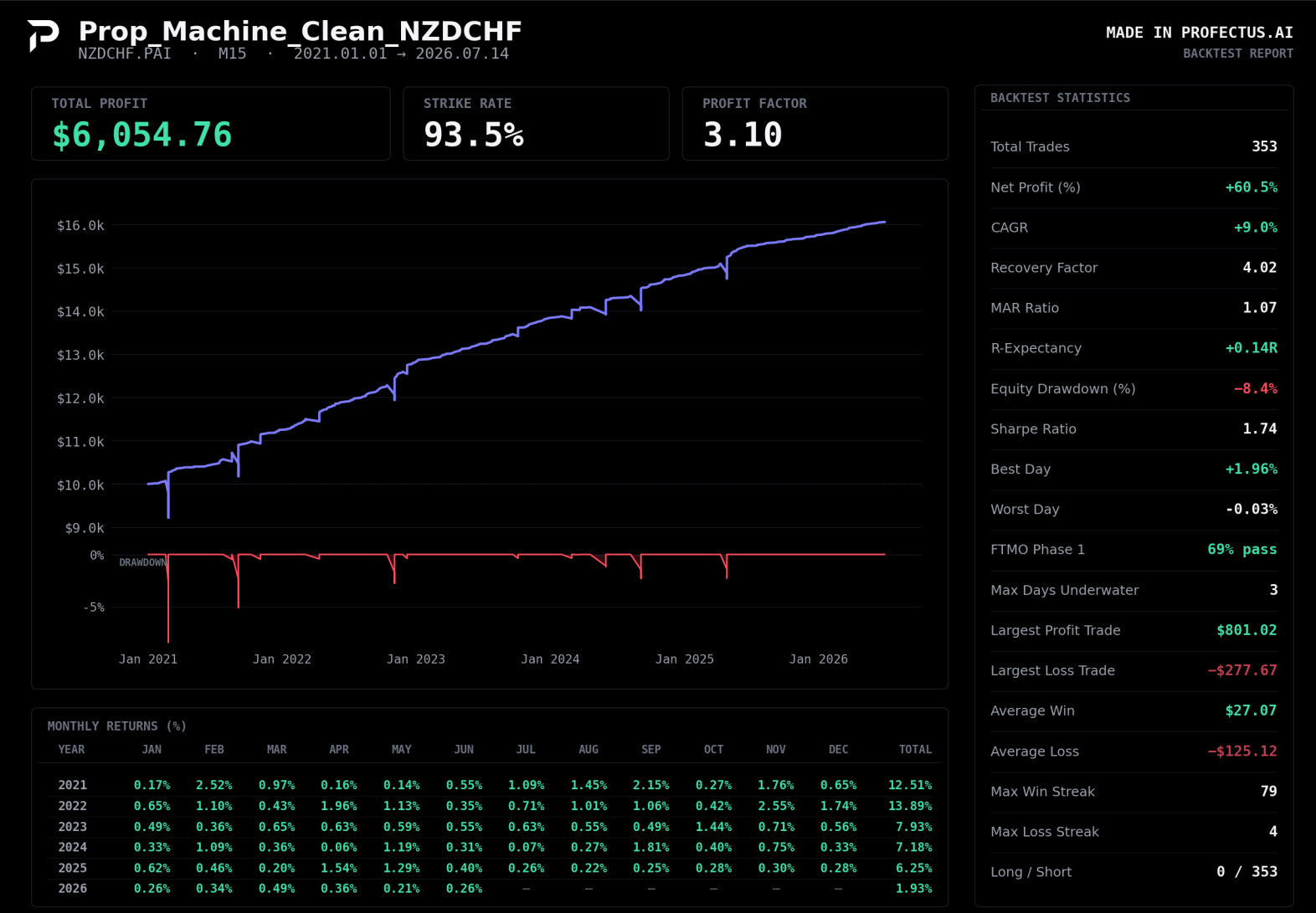
This template is designed to run on the 15-minute timeframe, with the best backtest results on NZDCHF
You might also want to watch the full YouTube video on this Prop Machine strategy here to get the full explanation of the strategy, the chart examples, and the Profectus AI blocks used to automate it.
Why Use Prop Firm Accounts for This Strategy
In a private account, you are trading your own money. Every large drawdown directly affects your own capital. That means a strategy with a hidden blow-up risk is usually a terrible idea, no matter how good the equity curve looks before that point.
In a funded prop firm account, the account itself is usually demo capital, but the payouts are real. This creates a very different risk-reward situation. You only risk losing the funded account if you breach the maximum permitted drawdown.
The strategy in this article is a perfect example of that. It has a high strike rate because it uses a small target and adds positions when price moves against the first trade. This can make the strategy look very consistent for a long time.
But the risk is also very clear. Price might continue to deviate further away from the mean and the positions get more and more in drawdown. At some point, the drawdown is unrecoverable, and the account could blow up.
That is why you must understand that this strategy is a prop firm payout strategy, not a safe long-term private portfolio strategy.
Prop Machine Strategy Rules
We’re taking a slightly different approach than usual, so we are going to focus on the sell side only for this strategy. Let’s dive into the strategy rules:
- Run on the 15-minute timeframe.
- Only trade between 02:00 and 20:00.
- Candle Close, Candle ID 1 must be above the upper Bollinger Band.
- RSI must be above 70.
- On the 1-H timeframe, the candle high must be above the upper Bollinger Band.
- Place a sell pending order at the candle close (step 3,4) with a 2-pip offset.
- Use fixed volume position sizing.
- Use a large stop-loss, such as 1000 pips or no stop loss at all.
- Target the Bollinger middle line on the first sell order.
- Expire the pending order after 15 minutes if it is not triggered.
- If the first trade doesn’t reach the profit target, we add another sell trade with the same size if the drawdown input value is reached
- From here on, we wait for the basket of trades to reach the combined profit target, or get further into drawdown to trigger the next position with double the lot size of the previous trade.
- Repeat step 12
Automating the Strategy in Profectus AI
Now let’s walk through how the strategy is built inside Profectus AI.
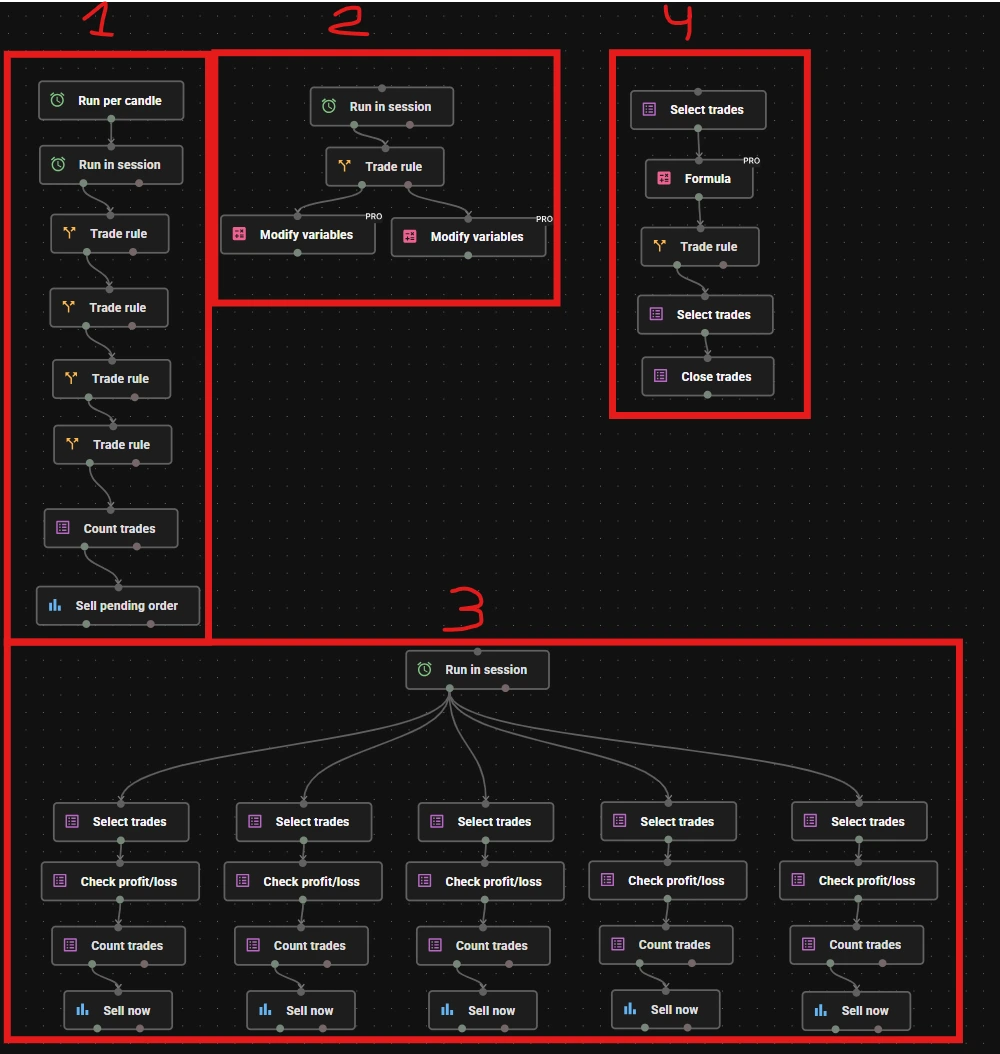
The number of blocks might seem a bit overwhelming at first, so let’s divide it into bite-sized pieces.
- Initiate the variables. As always, we start by creating our inputs and variables:
Variables
Floating_profit
HTF_confluence
For the variables we use default values 0
Inputs
Profit_float: 150
Floating_loss: 150
SL_Pips: 1000
Start_time (time): 02:00
End_time (time): 20:00
Lotsize_1: 0.1
Lotsize_2: 0.2
Lotsize_3: 0.4
Lotsize_4: 0.8
Lotsize_5: 1.6
Lotsize_6: 3.2
Please be mindful to change these settings to your personal preference. They are just the settings we used to test the strategy.
- We start with the time blocks. Put a run per candle block followed by a run in session block. Use the time inputs on the run in session block for your time configurations.
- Trade Rule Bollinger Band Close. Check if:
Candle close Candle ID 1 > Bollinger band (default settings) Upper Line - Trade Rule RSI. Check if:
Indicator Relative Strength Index (period 10) > 70 - Trade Rule HTF confluence. Check if:
HTF_confluence = 1 - No open trade. Use a Count trades block with open trades and pending orders = 0
- Sell pending order.
Open price: Candle close candle ID 1, Price offset: 2
Money management: Fixed volume Lotsize 1 (the input)
Stop-loss: Fixed pips SL_Pips (the input)
Take-Profit: Custom price level -> Indicator-> Bollinger Band Middle Line
Order expiration: 15 minutes
Group Number: 1 (IMPORTANT) - Higher timeframe confluence
Run in session block (start time and end time inputs) -> Trade Rule Block (Candle high Candle ID 0, Timeframe 1H > Indicator Bollinger Band Upper Line, Timeframe 1H
True output = Modify variables HTF_confluence = 1
False output = Modify variables HTF_confluence = 0
- Start with another Run in Session block. Put the same time inputs as before in this block. We’re now going to branch out to 5 modules, all with the same blocks and structure, just with different input values per module.
- Scale-in Module 1.
Select Trades Block: Group number 1 → Check Profit/Loss Block:Type Loss, => Floating_loss (the input) → Count Trades Block: Trade Count = 0, Order Count = 0, Type = Sells only, Group numbers = 2,3,4,5,6 → Sell Now Block: Risk = Fixed Volume, Amount = Lotsize_2 , Stop Loss Mode = Fixed pips, Amount = SL_Pips, Take Profit = None, Group Number = 2
- Scale-in Modules 2,3,4,5.
For these we will be using the same blocks and logic as the previous step, except that we’re now using different group numbers. To be precise:
Select Trades Block: Group number, +1
Count Trades Block: Group number, remove the lowest digit
Sell Now Block: Group number +1
So for the 2nd module you would do:
Select Trades Block: Group number = 2
Count Trades Block: Group number = 3,4,5,6
Sell Now Block: Group number = 3
And so on.
- Select trades. We select all open trades using the Select Trades Block with Group Number = 1,2,3,4,5,6
- Formula for floating profit. We use a formula block to calculate Floating_profit
Floating profit = Account Equity - Account Balance - Trade Rule block. Check if Floating_profit is bigger than => Profit_float (the input)
- Close all open trades. Take another Select Trades Block with Group number = 1,2,3,4,5,6 and connect it to a Close Trades block
Quite a hefty system to build, but you are now learning to use a different kind of management to scale into positions.
Get Access to the High Win-Rate Prop Firm Strategy Template
Want to see how the High Win-Rate Prop Firm Strategy works when fully automated?
Access the automation template used to turn this trading concept into a deployable MQ5 trading bot inside Profectus AI. The template includes the 15-minute Bollinger Bands and RSI entry logic, the higher-timeframe confluence variable, the group-number scale-in system, and the floating profit basket close module.
You can test it on different symbols, adjust the fixed lot size, change the session window, change the floating loss threshold, adjust the profit float target, and experiment with the scale-in structure.
Just remember the most important warning: this is a martingale-style strategy. It can look very consistent, but it carries serious blow-up risk.
Disclaimer: Templates are for educational purposes only!
👉 Get the Prop Machine Automation Template → Template Link
This template is designed to run on the 15-minute timeframe, with the best backtest results on NZDCHF
Other related blog posts
Dive into a world of knowledge, trends, and industry updates on the Variable blog. Our curated content covers a spectrum of topics.