The Best Fibonacci Strategy Automated
Identify impulsive market moves with a very simple rule and apply Fibonacci Retracements for reliable trade entries
The Best Fibonacci MT5 EA
The Fibonacci indicator is a great tool to find trading opportunities in trending markets. However, what exactly is a trending market, and how do you identify a strong move? The Fibonacci tool is often used in a very subjective way, which makes it less reliable. We take away the subjectivity by setting clear rules for how and when to use the Fibonacci tool, and how to build a powerful but simple Metatrader 5 EA using it.
Access an enhanced automation template used to turn this trading concept into a deployable MQ5 trading bot inside Profectus. This template has a trade execution module included, so you can start testing it right away!
Disclaimer: Templates are for educational purposes only!
👉 Get the Best Fibonacci Automation Template → The Best Fibonacci Strategy Profectus Template
You might also want to watch the full YouTube video on the Best Fibonacci strategy here to get an in-depth explanation of the pattern.
Identifying the move
In manual trading, Fibonacci is often used in a very subjective way. There are so many ways you can draw the retracements, and manual trading strategies often lack the exact rules to identify point A and point B of a move. Being able to identify the move is the key ingredient for successfully using Fibonacci in your trading.
We have made it incredibly simple to identify exactly which price to use for your Fibonacci retracements. The first thing is that we look for a strong move, or impulse, as we call it, using only 5 candlesticks.
For a bullish move, the low of the most recent candle (candle ID 1) has to be higher than the low of 5 candles before that (candle ID 5). These 5 candles make up our move, and with this simple rule, we have already established that price is moving up.
Identifying the impulse
Now that we have identified the candles we will use to measure the move, we have to check if this move is actually a strong move or impulse. We do this by comparing the distance from the high to the low of the move against a measurement of volatility. For this measurement of volatility, we use the standard current ATR value and multiply it by 4. This measurement of volatility is a very simple way of setting a threshold for what an impulsive move could look like without having to guess.
The actual comparison simply means that we want to see the distance of the move (between the high of Candle ID 1 and the low of Candle ID 5) being bigger than the current ATR value multiplied by 4 (the measurement of volatility). If this is the case, it tells us that the move we have identified is larger than a normal measurement of volatility over that same period and could thus be classified as impulsive.
Entering on the Fibonacci retracement
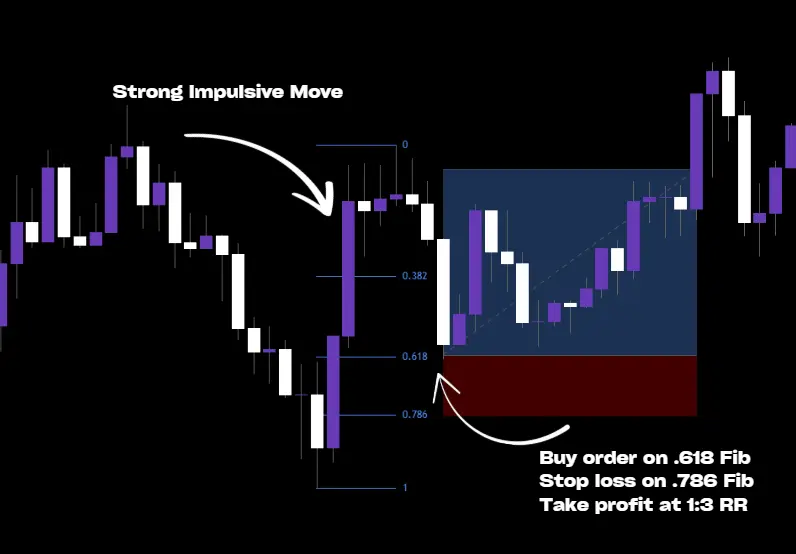
The last part of the strategy is to actually find a trade entry, and this is where the Fibonacci retracements come in. The goal is to wait for a pullback after the strong impulsive move to enter the trade with the best risk-to-reward ratio. For this strategy, we are simply going to place a buy pending order on the .618 Fibonacci retracement with a stop loss on the .786 retracement.
The beauty of this strategy being automated in Profectus AI is that you can easily test all kinds of combinations of entries, stop losses, and take profits. In the template, we have pre-programmed the calculations for the following Fib retracements:
.382
.618
.786
You can use these in combination by simply changing the inputs in the Buy Pending Order block.
Fibonacci Strategy rules
The exact rules for this strategy are the following:
- Every candle, check if the low of Candle ID 5 (5 candles back) is lower than the low of Candle ID 1 (the previous candle). This shows the market is moving bullish
- We save the high of Candle ID 1 and the low of Candle ID 5 as our point A and point B of the move
- Calculate if the move is impulsive by comparing the distance of point A and point B against the current ATR value multiplied by 4. If the distance of the move is greater than the volatility threshold, we can say the move is impulsive
- Calculate the Fibonacci retracements of the move
- If there is no open trades, place a buy pending order on the .618 Fibonacci retracement level, with a stop loss on the .786 level and a target of 3x the stoploss size for a 1:3 risk-to-reward ratio.
- If an order is not triggered, it will be automatically removed after 6 hours and the system will look for new opportunities
This is what a trade example of this strategy looks like on the chart:
You can see that this strategy is fully mechanical and thus can be automated easily in Profectus AI. The beauty of the strategy is that it captures momentum and thus helps identify strong moves to get in on.
Automating the Best Fibonacci Strategy
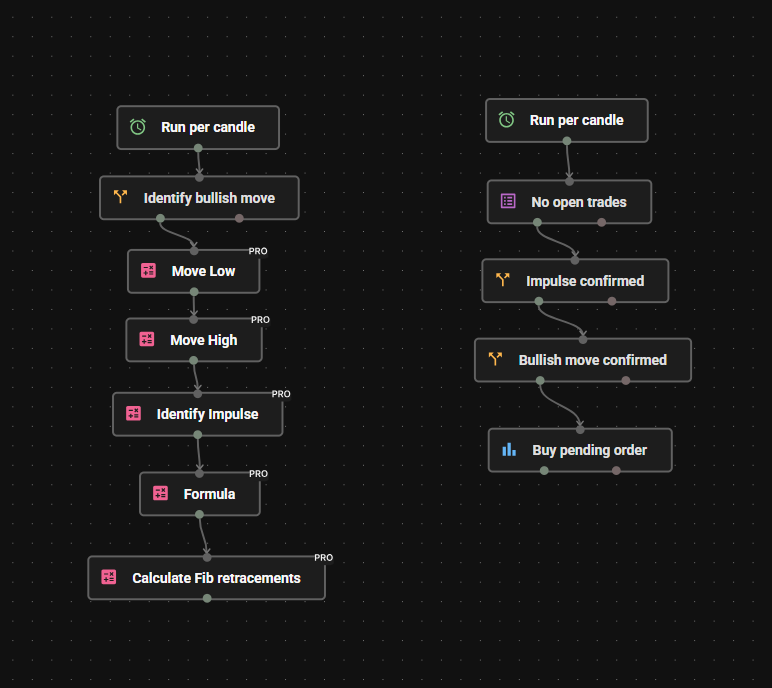
Now that we’ve explained the rules and shown you what a trade setup looks like, let’s automate it together in Profectus AI.
It’s one of the easier strategies to automate and requires only a few blocks.
- Initiate the variables. We start by putting the following variables in the Variables list. All are numbers and have a value of 0 by default:
high
low
highlow
highlowfib1
highlowfib2
highlowfib3
fib1
fib2
fib3
impulse
ATRmove
- Run per candle. We start the EA by checking all the rules once per candle
- Trade rule for identifying a bullish move. Put a trade rule block with the following rule:
Candle low, Candle ID 5 < Candle low, Candle ID 1 - Assign the move high and low to variables. Use 2 modify variable blocks to assign the high and low to the variables high and low.
High = Candle High, Candle ID 1
Low = Candle Low, Candle ID 5 - Identify the Impulse using Formula block. We use 2 simple calculations for this
Impulse = high - low
ATRmove = Indicator Average True Range (period 14) * 4 - Calculating the Fibs using 2 formula blocks. Formula block 1:
Highlow = high - low
Highlowfib1 = highlow * 0.382Highlowfib2 = highlow * 0.618
Highlowfib3 = highlow * 0.786
And for Formula block 2:
Fib1 = high - highlowfib1
Fib2 = high - highlowfib2
Fib3 = high - highlowfib3 - Check if no open trades. Count trades block with 0 orders and 0 open trades
- Confirm Impulsive Move. Trade rule block checking if:
Impulse > ATRmove - Buy pending order.
Open price: Custom price level, fib2
Stop loss: Custom price level, fib3
Take Profit: 300% of stoploss
Expiration: 6 hours
Get Access to the Best Fibonacci Strategy Template
Want to see how the Best Fibonacci Strategy works when fully automated?
Access an enhanced automation template used to turn this trading concept into a deployable MQ5 trading bot inside Profectus. This template has a trade execution module included, so you can start testing it right away!
Disclaimer: Templates are for educational purposes only!
👉 Get the Best Fibonacci Automation Template → The Best Fibonacci Strategy Profectus Template
This template is designed to run on the 1H Timeframe
How to run the Strategy in Metatrader 5?
We have written a full article to get you started in Metatrader 5 and how you can run any automated strategy, such as the Best Fibonacci strategy, as an Expert Advisor yourself.
Read the full guide here to run your first trading bot in MT5
Other related blog posts
Dive into a world of knowledge, trends, and industry updates on the Variable blog. Our curated content covers a spectrum of topics.