Building a Mean Reversion Strategy - Bollinger Bounce
Build a simple and powerful Mean Reversion Strategy in Profectus using the Bollinger Bounce method
Mean Reversion Strategies
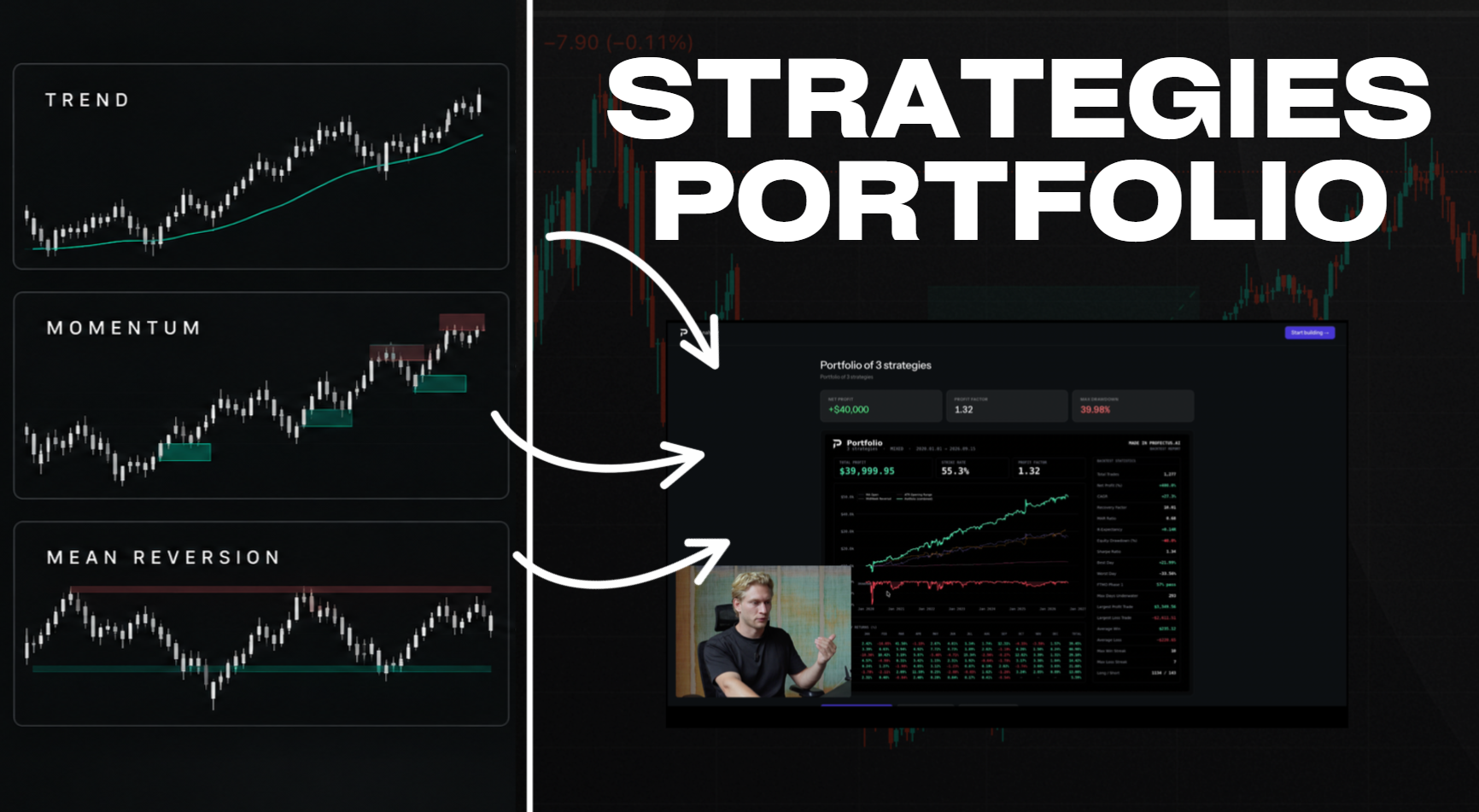
We have been sharing a lot of systems with you already, and I thought it was time for something we haven’t shared before. We focused a lot on breakout and trend-following strategies, but now we are going to dedicate an entire season to the art of mean reversion. We will be sharing 3 strategies, each with a unique approach but all built around the concept of price moving back to its mean.
Disclaimer: Templates are for educational purposes only!
👉 Get the Bollinger Bounce Template → Template Link
This template is designed to run on the 4-hour timeframe, with the example being on AUDJPY
What Are Mean Reversion Strategies
Mean reversion strategies, as the name suggests, are strategies that are based around price moving back to a mean or average. It suggests that price has drifted too far away from a mean, and that there is a high probability that it will return back to this mean at some point. In Forex, this is particularly true because the market tends to be more range-bound than stocks, for instance.
A Mean Reversion strategy generally doesn’t have a lot of trades because we are looking to trade only when the market is moving too far away from the mean. You could say we are looking at market inefficiencies.
Before diving into this week’s strategy, let’s share a very simple mean reversion strategy example. Let’s say that we take the 50-period EMA as our mean price, we can put a threshold for how far price can move away from this EMA before it’s reaching inefficient territory. We can very simply say that if price is at any moment in time 1% below the 50 EMA on the 1-hour timeframe, it has moved so far away from the mean that there is a high likelihood that it will revert back in the near future. You can take a buy position, set a relatively wide stoploss and close the trade for a profit when it taps the 50 EMA again.
Now, let’s get into this week’s mean reversion strategy.
The Bollinger Bounce Strategy
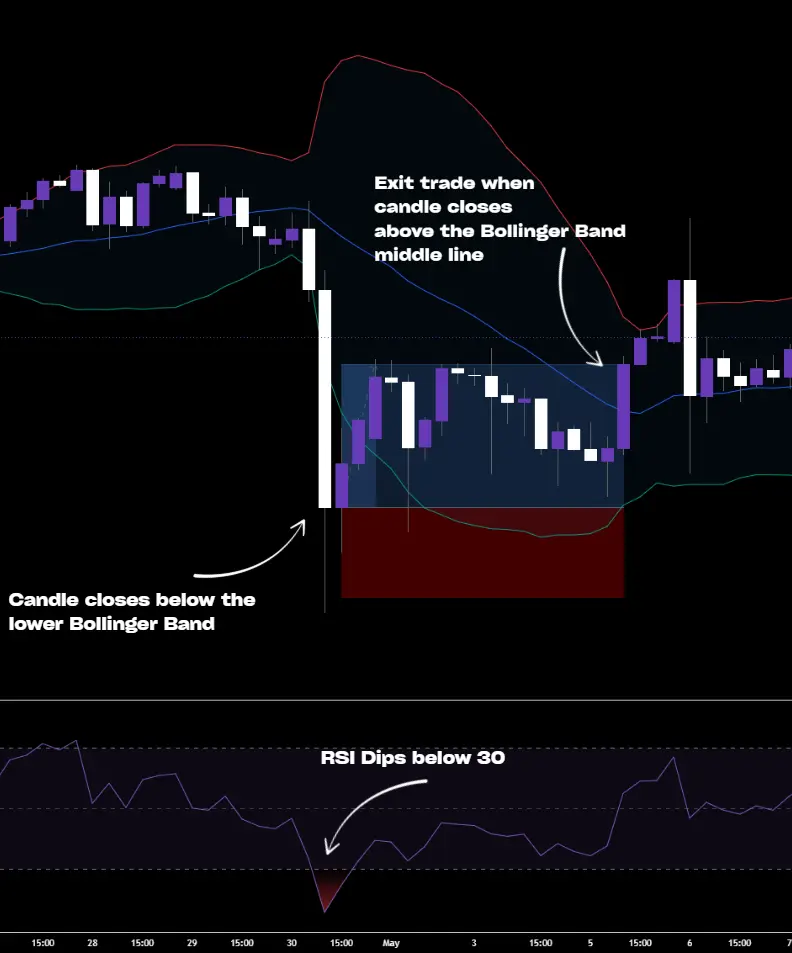
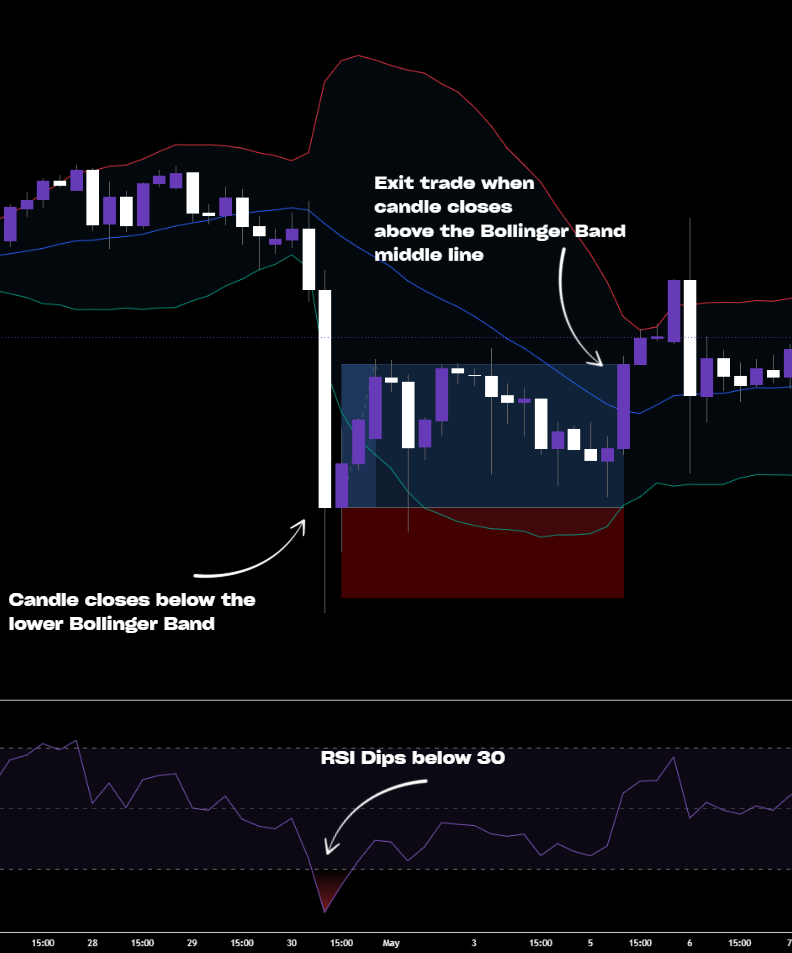
The Bollinger Bounce strategy is a very simple strategy, based on 3 indicators to quantify when price moves too far away from the mean. Let’s go over the rules:
- Between normal trading hours (01:00-20:00), we check the conditions on every candle close
- We check if a 4-hour candle closes below the 20-period lower Bollinger Band
- At the same time, we check if the RSI (10) is below 30
- To confirm that we are still in an uptrend, regardless of this pullback, we want the previous daily candlestick to close above the 20-period EMA
- We check that there are no open trades and that there is no news within 15 minutes of opening the trade
- We open the trade with a 50-pip stop loss and a 5R take profit
- We close the trade early when price closes above the middle Bollinger Band
Very easy to build and very clear rules to follow.
Building the Bollinger Bounce Strategy in Profectus AI
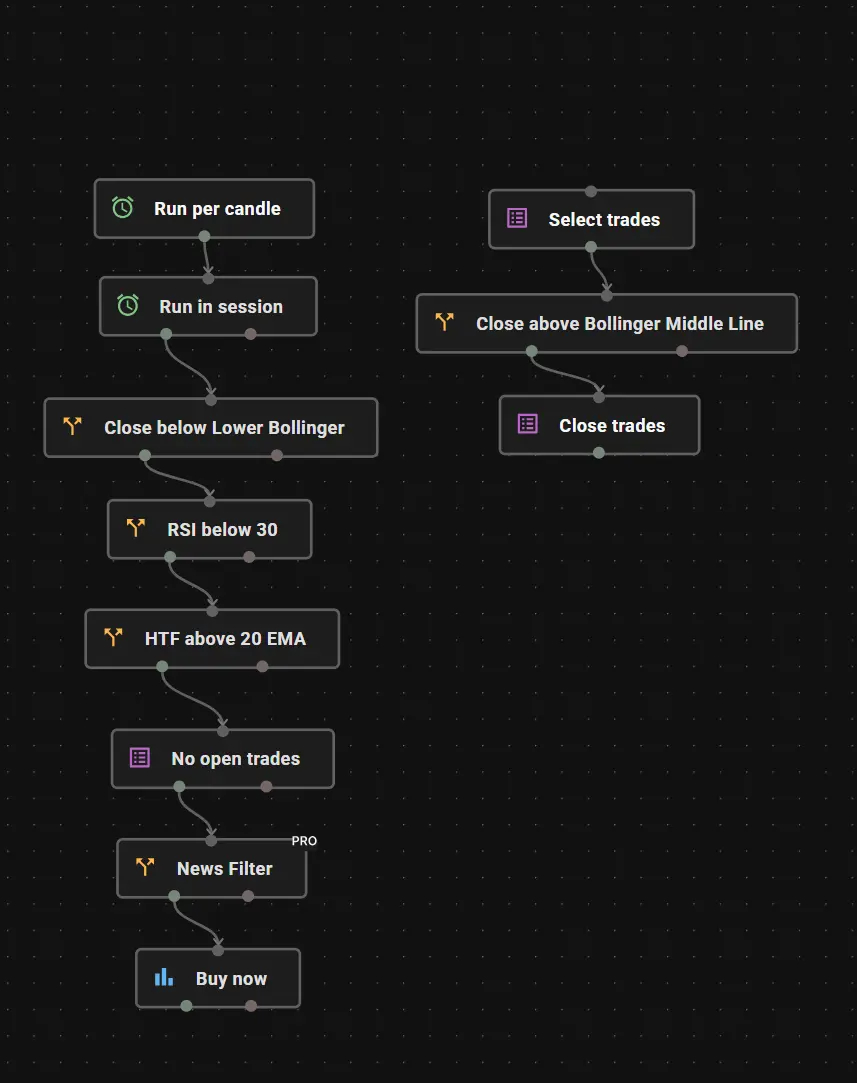
For this build, we are not using any variables and thus it’s super easy and fast to build. Let’s build it together:
- Start with a Run Per Candle block and attach it to a Run In Session block. Set the time in the Session block to 01:00-20:00
- Connect a Trade Rule block. In this first Trade Rule block we check the close below the Bollinger band by checking:
Candle Close Candle ID 1 < Bollinger Band Lower Band (period 20) - Connect another Trade Rule block to check the RSI. Check if:
Relative Strength Index (RSI, Period 10) < Value 30 - Connect another Trade Rule Block to check the HTF confluence. In this block we check:
Candle Close Candle ID 1 (Daily timeframe) > Moving Average period 20 (Exponential, Daily Timeframe) - Check for no open trades. Connect a Count Trades block and put open trades to = 0
- Check if there is news coming soon. Connect the News Filter block and set the desired time to before and after the news event. By default, we decide not to trade when it’s 15 minutes before the news and 5 minutes after the news.
- Buy now. Connect the Buy Now block and put the desired risk per trade. Set the following:
Stop loss: 50 pips
Take profit: 500% of Stop loss - Select Trades block. Get a Select Trades block and put Trad Type on Open Trades
- Check for a close above the Middle Bollinger Band. Get a Trade Rule block and check:
Candle close Candle ID 1 > Bollinger Band Middle Band (period 20) - Close open trades. Add a Close Trades block to close the open trade when the price crosses the Middle Bollinger Band.
Get Access to the Bollinger Bounce Mean Reversion Strategy
Want to see how the Bollinger Bounce Strategy works when fully automated?
Access the automation template used to turn this trading concept into a deployable MQ5 trading bot inside Profectus AI. The template includes the entry logic and the trade close module. It’s ready for testing!
You can test it on different symbols, adjust the timeframe, change the session window, and change the floating parameters for entering and exiting the trade.
Disclaimer: Templates are for educational purposes only!
👉 Get the Bollinger Bounce Template → Template Link
This template is designed to run on the 4-hour timeframe, with the example being on AUDJPY
Other related blog posts
Dive into a world of knowledge, trends, and industry updates on the Variable blog. Our curated content covers a spectrum of topics.