Jesse Livermore - The Livermore System Automation guide
Jesse Livermore’s system was built around trend direction, pivotal points, and patience. Here’s how his classic trading logic can be turned into clear rules and automated in Profectus.
Jesse Livermore
Jesse Livermore was a bold American stock trader who is famous for his massive bets, high-leverage, and awareness of the psychological factors that ruin traders and investors.
He has designed multiple price-action systems and the one we are going to build in Profectus AI is a simplified version of his Pivotal Point strategy. We like to refer to this system as the Livermore System.
Watch the Jesse Livermore Video here.
Pivotal Points
Jesse Livermore believed in always taking the path of least resistance. He believed in market trends and tried to actively ride the market trends using large leverage. The Livermore System evolves around Livermore’s concept of Pivotal Points. Pivotal Points are areas that need breaking in order to confirm a continuing market trend. A Pivotal Point can be a recent swing high/low or a range high/low. His vision was that these are areas that need breaking in order to see a trend continue. However, the market needs to take a breather before it can continue with the trend.
We have simplified the strategy and made it completely mechanical. For that reason, we are only focusing on swing high points in this particular example.
The Swing Filter
The other concept of the Livermore System is the Swing Filter. This is where we try to take in consideration a pullback before a potential trend continuation. After price makes a swing high, you don’t want to enter the market right away in anticipation of a continuing trend upwards. Livermore believed that it makes more sense to let the market breathe for a while before it can continue with the trend. In normal price action terms this breather is called a pullback.
With the swing filter, we try to capture this pullback by measuring the distance of the pullback and comparing it against the ATR with a multiplier. The goal is to only continue with the setup if the pullback is significant enough, thus bigger than the ATR (multiplied by x). This significance rule makes sure that we’ve actually seen a pullback before blindly entering the market.
Disclaimer: Templates are for educational purposes only!
👉 Get the Jesse Livermore Automation Template → Jesse Livermore System Profectus Template
This template is designed to run on the Daily Timeframe.
.png)
The Livermore System trading rules
Let’s write out our version of the Livermore System trading rules:
- Find the swing high. The first step is that every day at 01:05, we mark the highest price of the last 3 candles. We want to see this being the swing high, followed by a pullback to confirm it’s a true swing high
- Anticipate the pullback. In order to do this, we have to measure the distance between the low of the most recent candle (candle id 1) against the highest price from step 1.
- Verify the pullback. For this step, we need to verify that there was an actual pullback. We do this by comparing the distance from step 2 against the ATR with an optional multiplier. The distance of the pullback needs to be greater than the ATR value (with the optional multiplier). This indicates a significant pullback and not just sideways slop or even trend continuation.
- Enter the trade. For the last step we delete any orders that are outstanding and place a buy pending order on the swing high
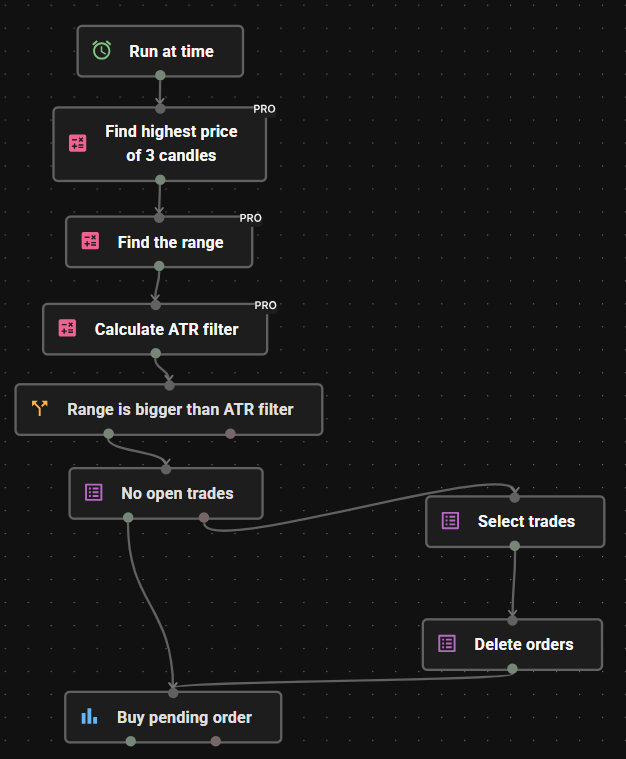
How to build the Livermore System in Profectus
Now that you know the rules of our version of the Livermore System, let’s build it in Profectus.
- Find and store the swing high. Use a Run at Time block and put the time at 01:05. Connect the first modify variable block. In this block, we store the highest price of candles 2-4 in a variable named Highestprice.
- Find the range. Connect a formula block to measure the difference between the Highestprice variable and the low of candle id 1. Store this is in a variable called Distance.
Distance = Highestprice - low of candle ID 1 - Calculate the ATR filter. Use another formula block to calculate the ATR value with a multiplier, and store this in a variable called Swingfilter.
Swingfilter = Indicator ATR Period 14 * Multiplier - Verify the pullback. Now you verify the pullback with a trade rule block that checks if:
Distance > Swingfilter - Place the trade. Now we can place a buy pending order on the variable value Highestprice and we add a POP SL and a % of stoploss-based target. We also check if there are any other trades open and delete them first if this is the case. This makes sure we are always considering the most recent valid setup.
Can You Automate Other Trading Legend strategies?
Yes. You can already find our legendary Rychard Wyckoff strategy here as well. We can automate any legendary strategy if it’s mechanical.
If a strategy has:
- Clear rules
- Defined conditions
- Objective execution logic
It can be automated.
Get Access to the Livermore System Automation Template
Want to see how this Jesse Livermore strategy works when fully automated?
Access an enhanced automation template used to turn this trading concept into a deployable MQ5 trading bot inside Profectus. This template has a trade execution module included, so you can start testing it right away!
Disclaimer: Templates are for educational purposes only!
👉 Get the Jesse Livermore Automation Template → Jesse Livermore System Profectus Template
This template is designed to run on the Daily Timeframe.
Other related blog posts
Dive into a world of knowledge, trends, and industry updates on the Variable blog. Our curated content covers a spectrum of topics.
.webp)