ICT Fair Value Gaps: How to Trade & Automate FVG
The ICT trading methodology has become one of the most discussed frameworks in modern trading. Yet among all ICT concepts, Fair Value Gaps (FVGs) stand out for one reason: They are structural, rule-based, and institutional.But here’s the paradox...
Why Fair Value Gaps Matter in Automated Trading
The ICT trading methodology has become one of the most discussed frameworks in modern trading. Yet among all ICT concepts, Fair Value Gaps (FVGs) stand out for one reason: They are structural, rule-based, and institutional.
But here’s the paradox.
Most traders understand Fair Value Gaps.
Very few can execute them consistently.
- Missed entries
- Late reactions
- Inconsistent rules
- Emotional overrides
This is exactly where automated trading and algorithmic execution outperform discretionary trading. Since we are building automated trading systems for Metatrader 5, we refer to those systems as EAs (Expert Advisors) from now on.
In this guide, you’ll learn:
- What Fair Value Gaps are (from an ICT perspective)
- How traders typically use them manually
- Why Fair Value Gaps are ideal for algorithmic trading
- How this concept can be fully automated and deployed on MetaTrader 5
- How you can access a ready-to-use Fair Value Gap automation template
1. What Is a Fair Value Gap (ICT Definition)
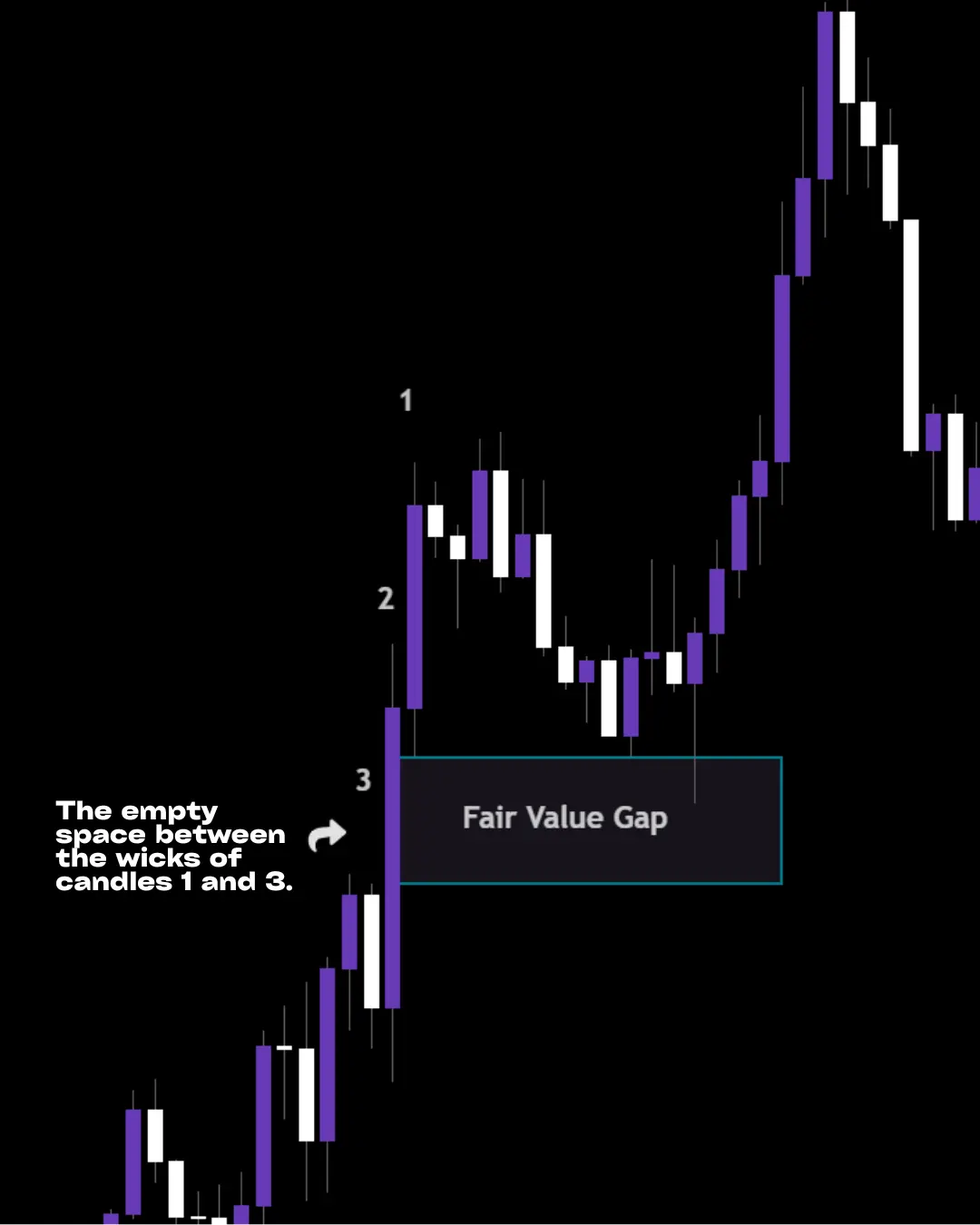
A Fair Value Gap represents a price imbalance created when the market moves aggressively in one direction, leaving inefficient trading behind. From an ICT perspective, a Fair Value Gap forms when: Price moves so quickly that buyers and sellers do not transact efficiently.
This shows dominance in one side of the market, usually caused by institutions’ buying or selling power. The idea is that the market seeks to rebalance this inefficiency later by revisiting this price area.
Structurally, an FVG is identified by:
- A three-candle formation
- Candles 1 and 2 showing impulsive strength
- A visible gap between the first and third candle wicks
This gap is where unfilled orders often remain. You can use this gap to take trade entries from or to add to your confirmations for a continuation of the move.
Once price leaves an inefficiency behind, such as a Fair Value Gap, the market often returns to these areas as a way to rebalance. As a trader, you can use these areas as a continuation or reversal confluence in your trading plan.
The way to identify and draw an FVG is fixed and highly mechanical. This makes FVGs one of the most structurally sound ICT concepts and an amazing concept to use in your automated trading strategies.
The key point: Fair Value Gaps are not entries by default — they are areas of interest governed by rules
Why Fair Value Gaps Are Ideal for Algorithmic Trading
A lot of the strategies taught nowadays rely on the discretion of the trader. This makes it nearly impossible to measure the true potential of a strategy. More importantly, it creates a large gap in results between the mentor teaching the strategy and the students trying to achieve the same results as the mentor.
We have ventured out on a mission to show you that every strategy can be automated, and that you can automate your own trading.
Fair Value Gaps can be easily automated, because they are:
- Rule-based
- Candle-structure dependent
- Timeframe-agnosti
- Objectively measurable
We already showed you how you can draw the FVG using only 3 candles and what the basic rules are. You can add your own discretionary rules to refine the Fair Value Gaps according to your liking.
The beauty of no-code trading automation in Profectus is that building and refining trading concepts or strategies only takes a few minutes.
Automating Fair Value Gaps Using Profectus AI
This is where automation becomes practical.
Instead of coding everything from scratch, Profectus allows traders to:
- Convert ICT logic into structured automation
- Define Fair Value Gap rules visually
- Apply consistent execution logic
- Test and iterate strategies without rewriting code
This approach bridges discretionary trading knowledge with no-code trading automation. By automating the FVG and other ICT trading concepts in Profectus, you can test how valuable they can be to your trading strategies in minutes.
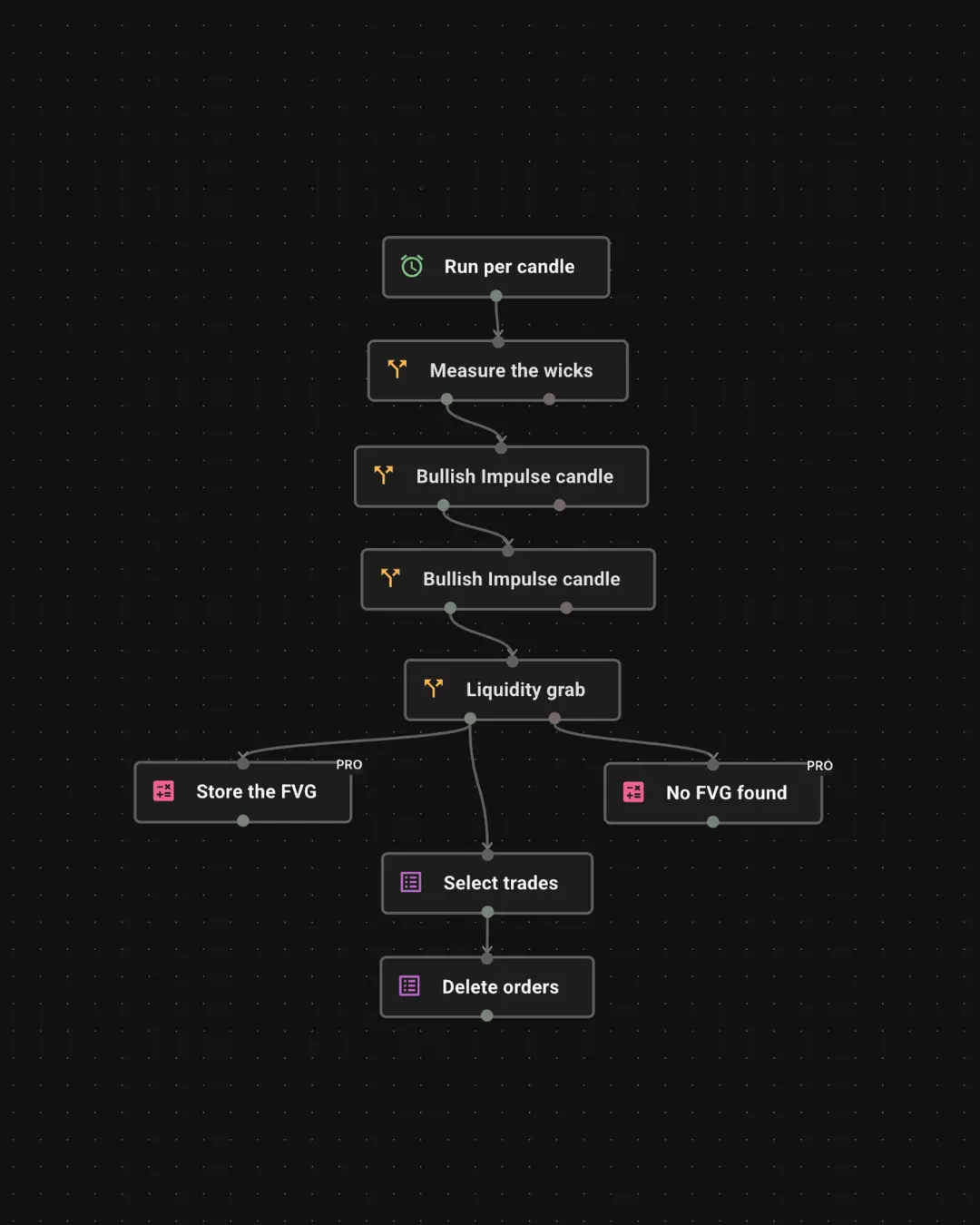
Don’t be intimidated by the names and the blocks. I named the blocks to make it easier for you to understand what we’re doing in each Profectus block. We can divide the creation of this no-code EA for FVGs into 3 steps.
- Run per candle block. Start with this block to make sure that every new candle that is formed on the chart, the EA runs through the whole process of finding an FVG, again and again.
- Defining the FVG using Trade Rule blocks. The 4 blocks that follow house the criteria for the FVG.
We already established that the FVG is a 3-candle pattern with:
2.1. A visible gap between the first and third candle wicks
2.2. Candles 1 and 2 showing impulsive strength
2.3. I added one extra rule for refinement: the Liquidity grab. The low of candle ID 3 needs to be lower than the low of candle ID 2.
- Store the FVG price levels. Once an FVG is found, we store it in a variable so that we can use this variable later to identify if the price comes back to it.
- Draw the FVG lines on the chart. For visual aid we can draw the lines of the FVG on the chart so we can see where it occurred. The beauty of automated trading is that you don’t need these visuals, but it helps in the beginning to see if the EA is doing what you want it to do.
And that’s it! It only takes a few minutes to drag-and-drop the blocks and build the FVG module in Profectus. You can now add an execution module to start taking trades, or add more rules to refine the FVG, or add more confluences to the strategy.
Deploying the Strategy as an MQ5 Bot on MetaTrader 5
Once automated, the Fair Value Gap strategy can be deployed as:
- An MQ5 trading bot
- Running 24/5 on MetaTrader 5
- Executing trades exactly as designed once you add buy/sell blocks and rules
Why MT5?
- Built-in algorithmic execution
- Broker compatibility
- Robust order handling
- Industry-standard platform for automated trading
This allows you to move from manual chart analysis to mechanical automated trading.
Can You Automate Other ICT Strategies?
Yes. In our blog library, you can find a selection of automated ICT concepts and strategies
If a strategy has:
- Clear rules
- Defined conditions
- Objective execution logic
It can be automated.
Fair Value Gaps are just one example of how institutional trading concepts translate perfectly into algorithmic systems.
The next step after understanding and applying the FVG concepts is to discover the Inverse Fair Value Gap theory by reading our full article here.
Get Access to the Fair Value Gap Automation Template
Want to see how this Fair Value Gap strategy works when fully automated?
Access an enhanced automation template used to turn this ICT concept into a deployable MQ5 trading bot inside Profectus. This template has a trade execution module included, so you can start testing it right away!
Disclaimer: Templates are for educational purposes only!
👉 Get the Fair Value Gap Automation Template → ICT FVG Profectus template
Watch a full youtube video here: Video Explainer building Fair Value Gaps in Profectus
Other related blog posts
Dive into a world of knowledge, trends, and industry updates on the Variable blog. Our curated content covers a spectrum of topics.